How women-led biotechs are reshaping the sector
22 Sept, 2026



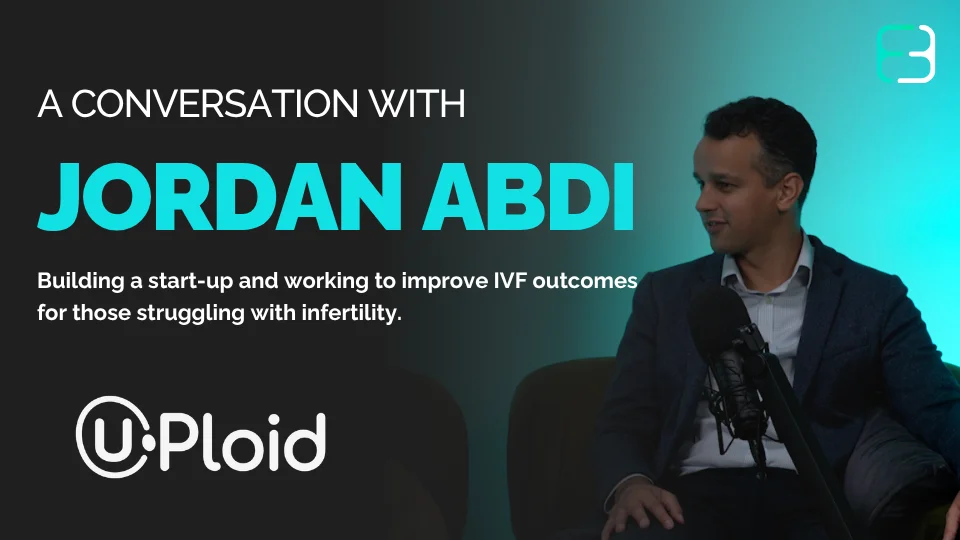
In the latest episode of our life sciences podcast, we welcomed Jordan Abdi, MD, Co-Founder and CEO of U-Ploid Biotechnologies, to the studio for a fascinating discussion surrounding IVF outcomes and the significant unmet needs in fertility healthcare.
Despite being a well-known procedure that has helped numerous families overcome the impossible, there remain countless couples who endure years of treatment only to have their dreams of parenthood unfulfilled. IVF has been in practice for 50 years but in the last three decades, no major innovation has taken place.
Jordan refers to IVF and fertility as ‘the unloved therapeutic area’. Despite having a mass population to treat, we continue to see very poor outcomes with success rates depending more on chance than on science.
As well as emphasizing the emotional and physical toll of repeated cycles and the reality that IVF does not guarantee a child – Jordan shares his story about growing a start-up and his mission to develop the first IVF therapy, so that one day anyone can start a family.
Keep reading for a breakdown of the conversation, or if you’d like to watch the podcast in full, click here.
Jordan began the conversation by telling us about his scientific background. He ended up in IVF and fertility health by accident after initially training as a doctor and working in rare diseases.
He had been looking at a certain asset on a project which led him to realize how infertility isn’t just an awful indication; it has no treatment. And unlike rare diseases, it has a mass population to treat.
Despite the first successful IVF baby being born nearly 50 years ago, very little has changed in the last 30 years – when something called Intracytoplasmic Sperm Injection (ICSI) was introduced in the early 90s. Most progress has been operational, rather than scientific breakthroughs that improve success rates.
Jordan argued that fertility has historically received less investment than other areas (like oncology and cardiovascular disease) because of its stigma and a lack of public attention.
“IVF is pretty much where it was three decades ago ... the foundations haven’t materially changed.”
Today’s patients are different from the ones that IVF was originally designed for. Initially aimed at young women in their twenties who had damaged or missing fallopian tubes, many people currently navigating fertility (who have delayed parenthood because of careers, finances and relationships) don’t know how drastically odds decline with age.
There is not enough awareness that IVF is a gamble. As said by Jordan, “It’s not paying for a baby. It’s ‘I want to roll the dice’”.
The reality is that IVF is physically demanding, emotionally exhausting, and financially difficult for many people. Throughout long periods of uncertainty, individuals and families carry hope, grief, resilience, and determination.
Then there’s the financial burden. Patients often spend tens of thousands of dollars or pounds just to take their chances. And because almost all IVF procedures are self-funded, many people choose to delay buying homes or even go into debt just to take a chance at starting a family.
It’s a massively taxing process, and the attached stigma means that couples often suffer the effects of infertility in private. It’s shocking that, given how common the indication is, there aren’t treatment options that can improve the odds of IVF success.
“One in six couples will face infertility. I don’t think that is well appreciated.”

Jordan founded U-Ploid in a bid to fulfil his vision of developing the very first treatment to help couples conceive. The company is currently developing Lyvanta™, a therapy which is designed to reduce failed IVF cycles by targeting meiotic aneuploidy.
As one of the most common causes of IVF failures, meiotic aneuploidy causes the embryo to have an incorrect number of chromosome copies, which sadly prevents it from surviving the early stages of growth.
This risk rises dramatically with age. For women who are 33 and over, meiotic aneuploidy will take place in more than 50% of eggs.
Jordan explained that Lyvanta™ is designed to work by reducing these errors that take place in egg cells so that more IVF cycles succeed. He also highlighted that the therapy fits seamlessly into existing clinics without requiring brand new, expensive equipment.
Having shown promising results in pre-clinical studies, Lyvanta is now being prepared to be tested in clinical trials.
As the conversation came to a close, Jordan reiterated his belief that fertility should be treated like any other major therapeutic area – with options that treat biology, not just a repetition of cycles.
With U-Ploid, he hopes that the future of fertility care has better success rates, fewer cycles, lower costs, and less emotional hardship. It’s time to move away from leaving things up to chance.
Many thanks to our guest speaker Jordan Abdi for sharing his insights with us. We’re keeping an eye on U-Ploid's progress and are excited for clinical trials to go ahead!